A complete ODIN Learning™ curriculum pathway for students, homeschool families, teachers, and future innovators — from the first look at the stars to aerospace engineering, satellites, electric vehicles, robotics, and future space careers.
OUDI D2® is the Master Intelligence Learning Coordinator for ODIN Learning™. On this page, OUDI D2® helps guide students through space exploration, future technology, aerospace systems, satellites, and the learning habits needed to become tomorrow’s builders.
This curriculum is designed to be easy enough for beginners and deep enough to inspire teenagers preparing for advanced study.
Students learn about stars, planets, moons, galaxies, gravity, orbits, the solar system, and Earth’s place in space.
Students learn how rockets launch, why satellites orbit Earth, and how space systems help communication, weather, navigation, and safety.
Students connect learning to aerospace, aviation, engineering, robotics, electric vehicles, artificial intelligence, and mission operations.
Simple, joyful lessons for children discovering space for the first time.
Space is the huge area beyond the sky. At night we can see the Moon, stars, and sometimes bright planets. Earth is our home, and space surrounds it.
The Sun gives Earth light and warmth. The Moon travels around Earth. Stars are far away and shine in the night sky.
Rockets are powerful vehicles that can travel into space. Children practice a launch countdown from 10 to 1.
Students begin connecting space with science, geography, communications, weather, and Earth observation.
Students learn the eight planets: Mercury, Venus, Earth, Mars, Jupiter, Saturn, Uranus, and Neptune. They compare rocky planets, gas giants, moons, rings, and distance from the Sun.
Satellites orbit Earth and help with maps, weather, communication, internet service, research, agriculture monitoring, and emergency response.
Students learn how viewing Earth from orbit helps people understand oceans, farms, storms, cities, forests, highways, ships, and airports.
Advanced students explore aerospace engineering, electric vehicles, AI, robotics, satellites, and future space missions.
Aerospace engineering studies aircraft, rockets, satellites, spacecraft, propulsion, structures, navigation, safety, and mission systems.
EV technology uses batteries, electric motors, power management, charging systems, software, and clean-energy thinking.
AI and robotics can help inspect systems, analyze data, assist crews, support mission control, and improve safety.
A rocket must create enough thrust to overcome gravity. Students can begin learning how mass, acceleration, fuel, and force work together.
Satellite networks can support communication, navigation, weather information, emergency response, internet coverage, aviation, shipping, agriculture, and global awareness.
Electric vehicles and future electric aircraft require battery systems that store energy, manage heat, deliver power safely, and communicate with control systems.
Earth observation can help monitor storms, oceans, forests, farmland, transportation routes, ports, airports, and large properties.
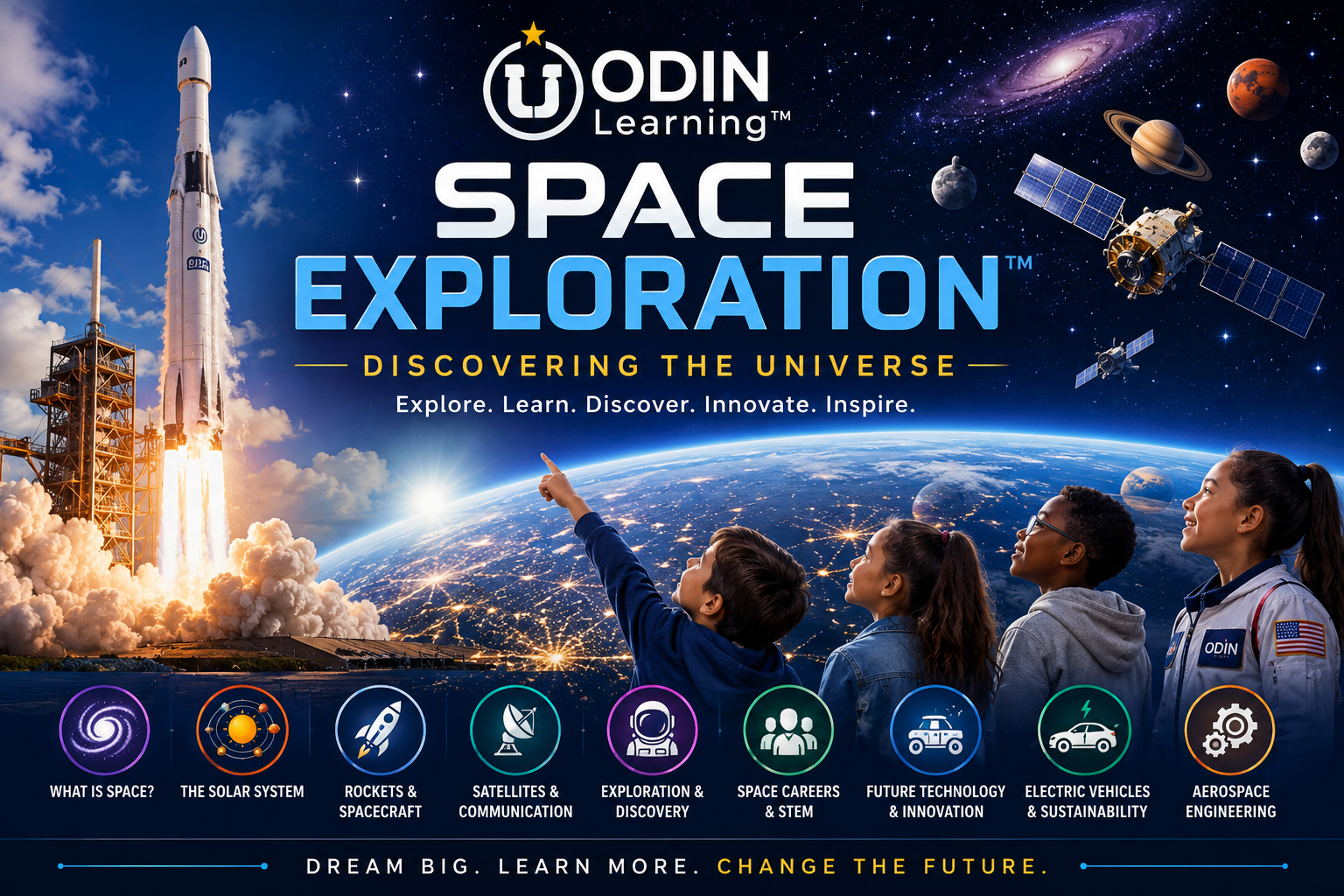
Space Exploration Academy™ connects directly to the ODIN Aerospace® vision: satellites, aviation, global communications, safety, emergency support, electric transportation, and future technology.
Students study modern spaceflight as a living field of innovation. They learn that today’s aerospace companies are building reusable rockets, satellite networks, lunar systems, robotics, and future exploration pathways.
This helps students understand that space is not only history — it is a career path, a technology path, and a future opportunity.
Hands-on projects help students turn curiosity into understanding.
Create a model showing the Sun and eight planets. Older students can label planet type, moons, and distance order.
Draw a satellite and label solar panels, antenna, sensors, camera, and communication system.
Design an electric vehicle, rover, spacecraft, or electric aircraft and explain what problem it solves.
This section helps teachers, tutors, and homeschool families use this page as a real lesson.
Young learners: 30 minutes
Ages 8–12: 45–60 minutes
Ages 13–18: 60–90 minutes
Paper, pencils, colored pencils, notebook, optional globe, optional cardboard, and internet access with adult supervision.
Students should understand basic space concepts, explain how satellites help Earth, and identify future technology careers.
Continue learning through reading, writing, math, science, and future technology.
Space exploration is not only about rockets. It is about curiosity, courage, science, teamwork, patience, creativity, and the belief that students can help build the future.
ODIN Learning™ encourages every student to ask questions, explore ideas, practice skills, and imagine what is possible.